What the Service Entrance Means
The service entrance is the point and associated equipment through which electrical power from a serving utility enters a facility’s electrical system. In everyday project discussions, the term may refer broadly to the conductors and equipment at the utility-to-customer interface, rather than to one universally defined cabinet or device. The precise boundary depends on the utility’s service arrangement, applicable electrical codes and the project documents. At this transition, incoming utility power is connected to the customer’s distribution system, where it can be controlled and distributed to downstream loads. Service-entrance equipment may include a main disconnecting means, overcurrent protection, metering provisions or a switchboard, depending on the design and governing requirements. These elements should not be treated as interchangeable: each has a specific role in isolation, protection, measurement or distribution. Confirm the intended meaning of “service entrance” in drawings and specifications before using it to define equipment scope.
Where Utility and Facility Responsibilities Meet
The service entrance is also an important coordination boundary. The serving utility establishes the available service arrangement and its requirements, while the facility design identifies how the incoming supply connects to customer-owned equipment and loads. The exact ownership, access and maintenance responsibilities are project-specific; the location of a disconnect or meter alone does not establish them. Early coordination helps resolve practical questions such as the service point, metering location, incoming conductor route, equipment access and who provides each component. Utility requirements can affect the arrangement and dimensions of the service area, so they should be obtained before equipment layouts are finalized. The electrical engineer, contractor and utility should coordinate the one-line diagram and physical plans, including any required separation or working clearances. Documenting the agreed boundary reduces gaps or duplicated scope between utility work, service conductors, metering and customer switchgear, and gives procurement a clearer basis for defining what the new equipment must accommodate.
| System | Voltage, phase, current and available fault current |
|---|---|
| Configuration | Lineup, protection, controls and enclosure as specified |
| Compliance | Applicable standards and listing confirmed for the assembly |
| Delivery | California and nationwide; schedule confirmed by quote |
How the Entrance Relates to Switchgear
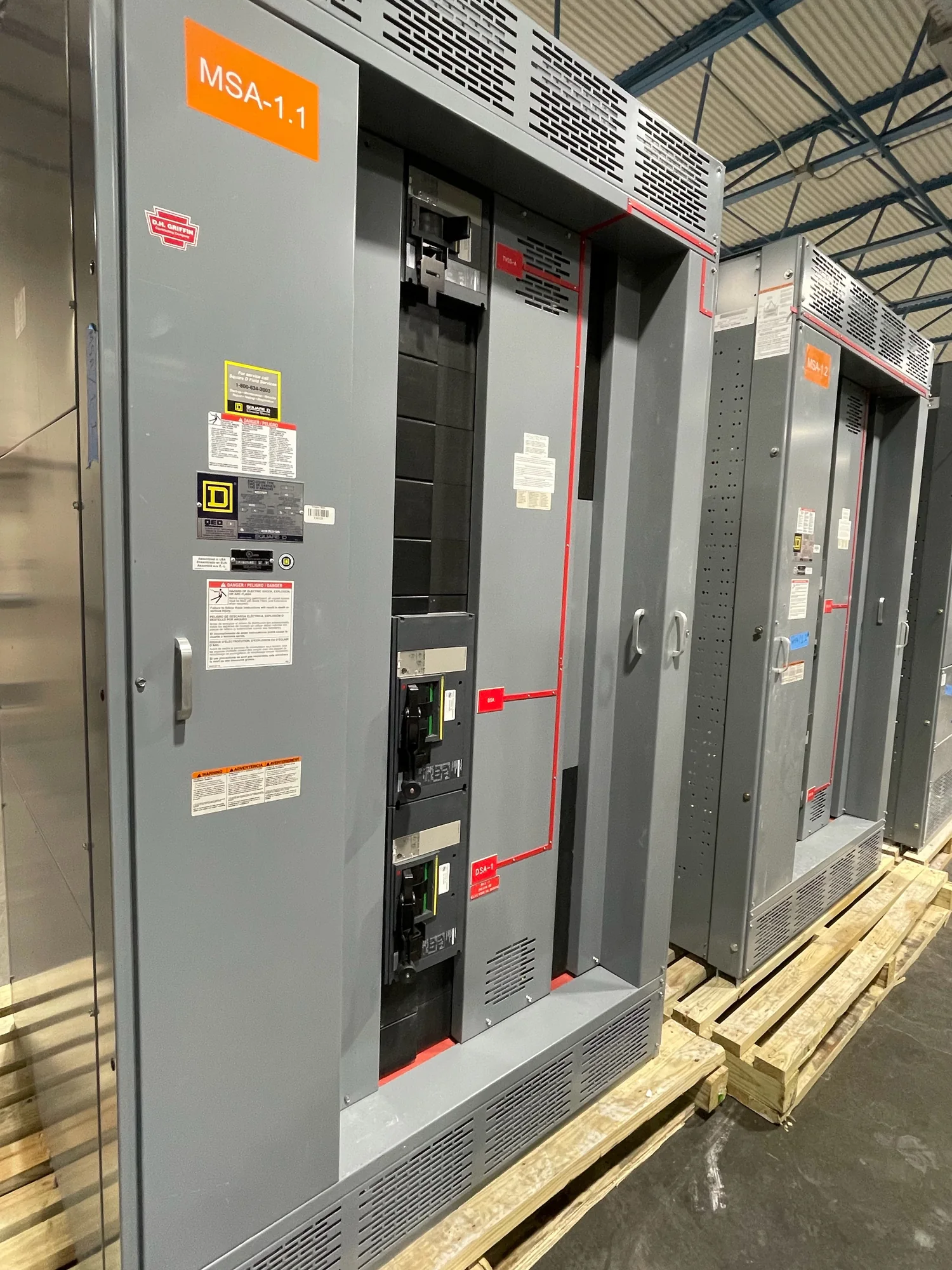
At many facilities, service-entrance equipment forms the first stage of the customer’s power distribution. A low-voltage switchboard may receive a utility service and feed distribution sections or downstream panels, but whether that arrangement is suitable depends on the project’s voltage, current, fault conditions, configuration and applicable requirements. Other services may use different equipment or a different division of functions. The service entrance is therefore not synonymous with a switchboard, switchgear lineup or main breaker. A meter can be part of the service arrangement without performing overcurrent protection; a disconnect provides a means of isolation but does not by itself establish the complete protection scheme. Designers must determine the required functions and equipment boundaries from the utility criteria, load study, one-line diagram and applicable codes. For a low-voltage switchboard, UL 891 may be relevant where applicable, but its mention does not establish that a particular assembly is listed. For medium- or high-voltage equipment, identify and verify the standards applicable to that specific equipment.
Key Design Inputs to Confirm
Before specifying service-entrance equipment, assemble the information that determines how the incoming supply must be handled. Useful inputs include nominal voltage and phase, the utility’s service configuration, available fault current at the point of connection, expected load, metering requirements and the location of the service point. Identify whether the utility or customer supplies incoming conductors and metering components, and clarify conductor entry, termination space, access and environmental conditions. The design team should also evaluate grounding and bonding, neutral arrangements, overcurrent protection, selective coordination and arc-flash considerations as applicable. Ratings are not assumptions to carry from one site to another: qualified professionals must establish the required equipment ratings and protective-device settings using project data and applicable codes. If the utility’s final fault-current information or connection criteria are pending, record that dependency and have the design reviewed when the data become available. Clear, current documents help equipment builders assess interfaces and avoid costly layout changes.
A Practical Path from Definition to Procurement
For a new installation, begin with a coordinated one-line diagram and the utility’s service requirements, then use them to define the service-entrance boundary in the equipment schedule and scope documents. State what the incoming equipment is expected to do, what sits upstream and downstream, and which party provides each interface component. Include relevant drawings, available ratings, fault-current information, load data, physical constraints and any specified standards for the equipment type. Ask the project engineer and utility to resolve ambiguities before release for fabrication; a label such as “service entrance” is not enough to establish breaker functions, metering scope or connection details. When requesting a switchgear proposal, identify the intended application and the information still awaiting confirmation so that open items can be reviewed rather than assumed. California projects and projects elsewhere in the United States may have different utility criteria and site conditions. Build in time for review, and treat schedule-sensitive options as subject to project-specific evaluation rather than guaranteed.