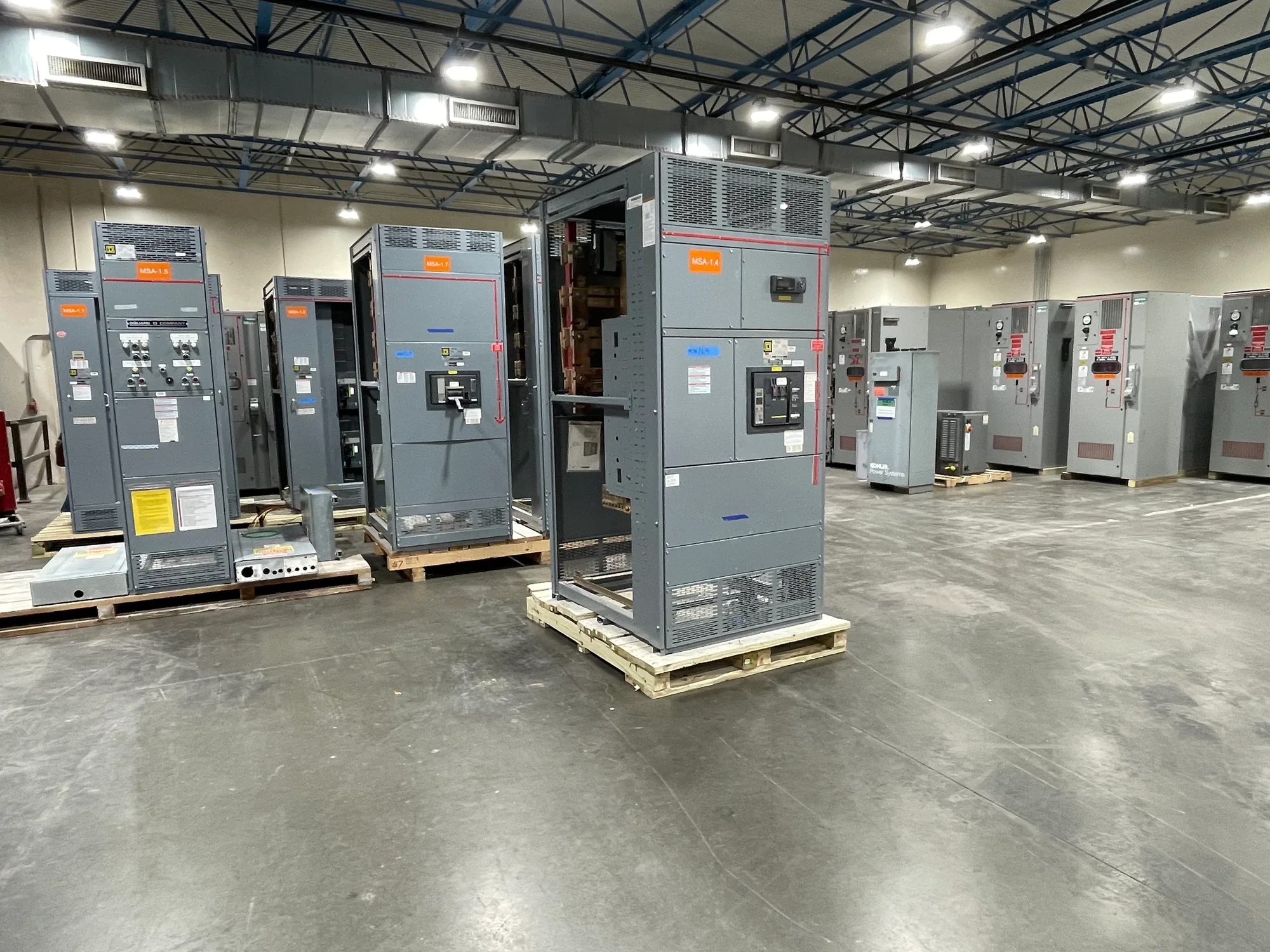
Switchgear, Switchboards and Distribution Equipment
Switchgear is an assembly of electrical components used to control, protect and isolate power circuits. The term often describes equipment that includes switching devices, protective relays, bus conductors and associated enclosures, but the exact arrangement depends on system voltage, application and governing requirements. A switchboard is generally a low-voltage distribution assembly with protective devices and circuits arranged to distribute power. Switchboards and switchgear may serve similar functions, yet they are not interchangeable labels for every construction or application. A panelboard is typically a smaller distribution assembly serving branch circuits, while a motor control center groups motor-control units and related equipment. A lineup is a set of connected sections assembled to operate as one system. When discussing equipment, identify its function, voltage class and installation context rather than relying on a generic name. That shared vocabulary helps engineers, contractors and buyers confirm that drawings, quotations and site requirements refer to the same type of assembly.
Breakers, Disconnects and Circuit Protection
A circuit breaker is a switching device designed to carry current under normal conditions and interrupt current when specified abnormal conditions occur. Its continuous-current rating indicates the current it is designed to carry under stated conditions; it does not by itself define how much fault current it can interrupt. Interrupting rating describes the maximum short-circuit current a device is intended to interrupt at a stated voltage. A disconnect, or isolating device, provides a means to separate a circuit or equipment from its source; the required switching and isolation functions depend on the application. A fuse protects a circuit by opening when current exceeds its operating characteristics, and its time-current behavior differs from that of a breaker. Protection settings determine when an adjustable protective device responds. They must be selected in coordination with connected equipment and upstream and downstream devices. Qualified professionals use system studies, device data and applicable codes to establish suitable ratings and settings; terminology alone cannot determine a safe selection.
| System | Voltage, phase, current and available fault current |
|---|---|
| Configuration | Lineup, protection, controls and enclosure as specified |
| Compliance | Applicable standards and listing confirmed for the assembly |
| Delivery | California and nationwide; schedule confirmed by quote |
Bus, Ampacity and Short-Circuit Ratings
A bus is a conductor, or group of conductors, that distributes electrical power among incoming sources and outgoing circuits within an assembly. Bus arrangement may be described as main bus, vertical bus or a tie bus that connects sections or sources. Ampacity is the current-carrying capacity assigned to a conductor or assembly under specified conditions. Temperature limits, enclosure design, installation conditions and other design inputs can affect that capacity, so an ampere value should be read in context. Short-circuit current is the large current that can flow during a fault; available fault current is the amount the electrical system can deliver at a particular point. An assembly’s short-circuit withstand or rating describes how it is intended to withstand fault current for a stated duration or operating condition. This is distinct from a breaker’s interrupting rating. Engineers compare the relevant equipment ratings with the calculated system conditions, including source changes and future capacity where applicable, before finalizing the design.
Relays, Coordination and Arc-Flash Terms
A protective relay monitors electrical conditions and initiates a response when measured values meet specified criteria. Depending on the design, it may command a circuit breaker to open for an overcurrent, ground fault or other detected condition. Selective coordination means arranging protective devices so that, for a defined fault, the device nearest the affected circuit operates before upstream devices, to the extent required by the design and applicable rules. Coordination depends on device characteristics, settings and system topology; it is not established by matching labels or ratings alone. An arc flash is a release of energy caused by an electrical arc. An arc-flash risk assessment evaluates hazards and informs appropriate safety measures, which may include boundaries, work practices and personal protective equipment. Incident energy is an estimate of thermal energy at a specified working distance under analyzed conditions. Results depend on system data, protective-device operation and assumptions. Qualified professionals determine protection and safety practices for the specific installation; glossary definitions are not a substitute for a project study.
Reading Specifications and Confirming Requirements
A one-line diagram is a simplified drawing that represents the electrical system and shows sources, buses, transformers and major protective devices. It provides an efficient map of system relationships, but it does not replace detailed drawings, schedules or equipment specifications. A specification may identify voltage, phase, frequency, continuous current, short-circuit conditions, enclosure requirements, metering, controls and connection details. Treat each value as a design input to confirm against the project documents, utility information and site conditions. For low-voltage switchboards, UL 891 may be a relevant standard where applicable; its mention does not establish that any particular assembly is listed or certified. Medium- and high-voltage equipment has standards specific to its type and application, which should be identified and verified for the project. When requesting a quotation or reviewing a design, provide current drawings, load information, system fault data, physical constraints and required functions. Resolve conflicting documents early, and have qualified professionals confirm protection, ratings and applicable codes before equipment is finalized.