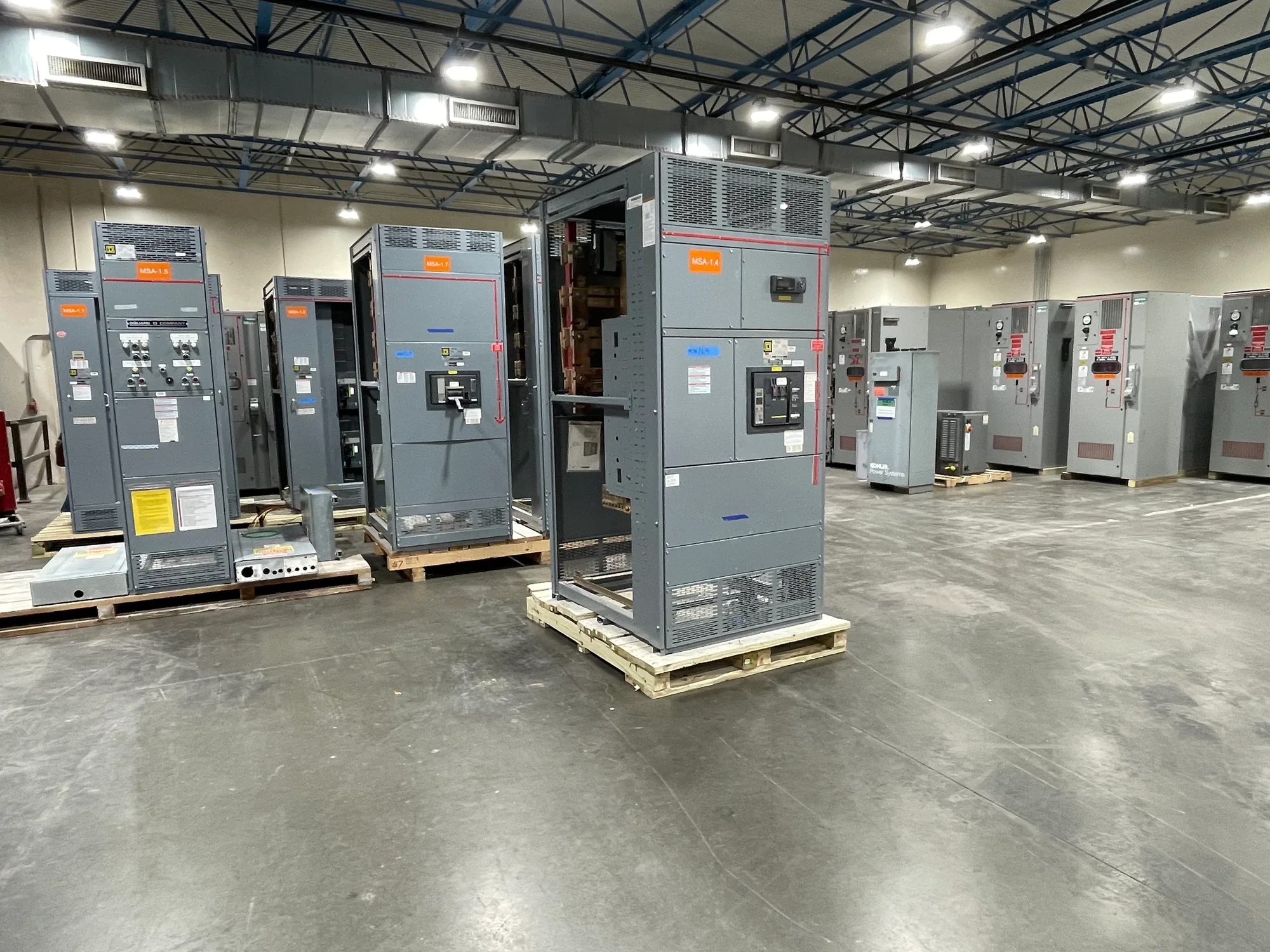
Plan Riverside Switchgear Around the Load
Riverside projects can involve manufacturing, warehousing, commercial facilities, public infrastructure and other demanding electrical applications. Each has a distinct load profile, operating schedule and consequence of interruption, so equipment planning should begin with the actual distribution design rather than a generic location-based assumption. Share one-line diagrams, load schedules, available fault-current information and the intended service voltage when requesting a project review. Identify present loads as well as planned additions, including large motors, process equipment, EV charging or expansion phases. These details help the engineering team understand feeder requirements, protection coordination and space for future circuits. Confirm whether loads are continuous, intermittent or subject to significant starting current, and identify any sensitive equipment that could be affected by switching events. A clearly defined operating need gives the project team a sound basis to discuss an appropriate new switchgear design and the information still needed before specifications are finalized.
Account for Inland Site Conditions
Riverside’s inland setting makes site conditions worth documenting, but climate alone does not determine an enclosure or equipment rating. Record the intended installation location, ambient temperature range, exposure to direct sun, dust, moisture, corrosive agents and nearby heat sources. For outdoor installations, note whether equipment will sit beneath a canopy, beside a roadway or in an area exposed to windblown debris. For indoor equipment, describe room ventilation, clearances, access restrictions and any unusual temperature or contamination concerns. These factors can influence design discussions, installation planning and maintenance access; they should be evaluated against the applicable project requirements rather than assumed from a city name. If the site has unusual environmental or operational conditions, provide photographs, room layouts and written specifications early. Qualified professionals should confirm applicable ratings, codes and protection requirements for the specific installation. The goal is to connect the equipment design to the real site, without over- or under-specifying based on broad regional assumptions.
| System | Voltage, phase, current and available fault current |
|---|---|
| Configuration | Lineup, protection, controls and enclosure as specified |
| Compliance | Applicable standards and listing confirmed for the assembly |
| Delivery | California and nationwide; schedule confirmed by quote |
Coordinate Delivery to the Project Site
Successful delivery depends on more than a destination address. Riverside-area project teams should identify the receiving location, site contact, delivery hours, truck access, unloading method and any restrictions on vehicle size or approach. Confirm whether the equipment must pass through gates, loading docks, narrow streets or construction-site routes, and whether overhead obstructions or turning areas could affect access. Discuss unloading responsibility and the availability of suitable lifting equipment before dispatch planning begins. If a project is phased, clarify which sections or assemblies are needed for each milestone and how the site will receive and protect them. Packaging, handling and storage arrangements should reflect the project’s schedule and exposure conditions. Delivery timing and available logistics depend on the equipment, production planning and destination details, so confirm them directly during project review. For sites with limited receiving capacity, early coordination can help identify practical constraints before they become installation delays.
Support Industrial and Expansion Projects
Industrial facilities often need continuity between existing distribution equipment and new capacity. To support a useful review, provide the existing system voltage, bus and feeder information, protective-device data, available drawings, and any known limitations in the present installation. Explain whether the project is a replacement, an addition or a new distribution point, and identify interfaces that must remain compatible with upstream and downstream equipment. Compatibility should be verified from documented electrical and physical requirements; similar appearance or nominal voltage does not establish interchangeability. Where the facility will expand, describe the expected sequence, future load assumptions and acceptable outage windows. Those inputs help the project team consider section arrangement, connection points and installation planning while qualified professionals determine protection coordination and code requirements. If the work involves the customer’s existing equipment, distinguish any modernization scope from the supply of new equipment. Early alignment among the owner, electrical engineer, contractor and equipment builder reduces ambiguity in drawings, responsibilities and commissioning preparation.
Confirm Coverage and Project Requirements
Switchgear Builder California serves customers in Riverside and across California, and nationwide shipping may be considered for projects beyond the region. Coverage, delivery arrangements and project support depend on the requested equipment, destination and scope, so confirm the details with the team rather than assuming a particular service or schedule. A strong inquiry includes the project address or receiving point, required delivery window, equipment type, electrical specifications, drawings, site constraints and the name of the project’s technical contact. Include the applicable standards specified for the particular equipment; UL 891 applies to low-voltage switchboards where applicable, while medium- and high-voltage equipment requires identification and verification of standards relevant to that equipment. Standards requirements and ratings must be confirmed for the specific design and do not, by themselves, establish a third-party listing. If timing is schedule-sensitive, explain the milestone and ask whether options can be reviewed; expedited possibilities remain subject to project review. With complete information, the team can clarify open questions and next steps.