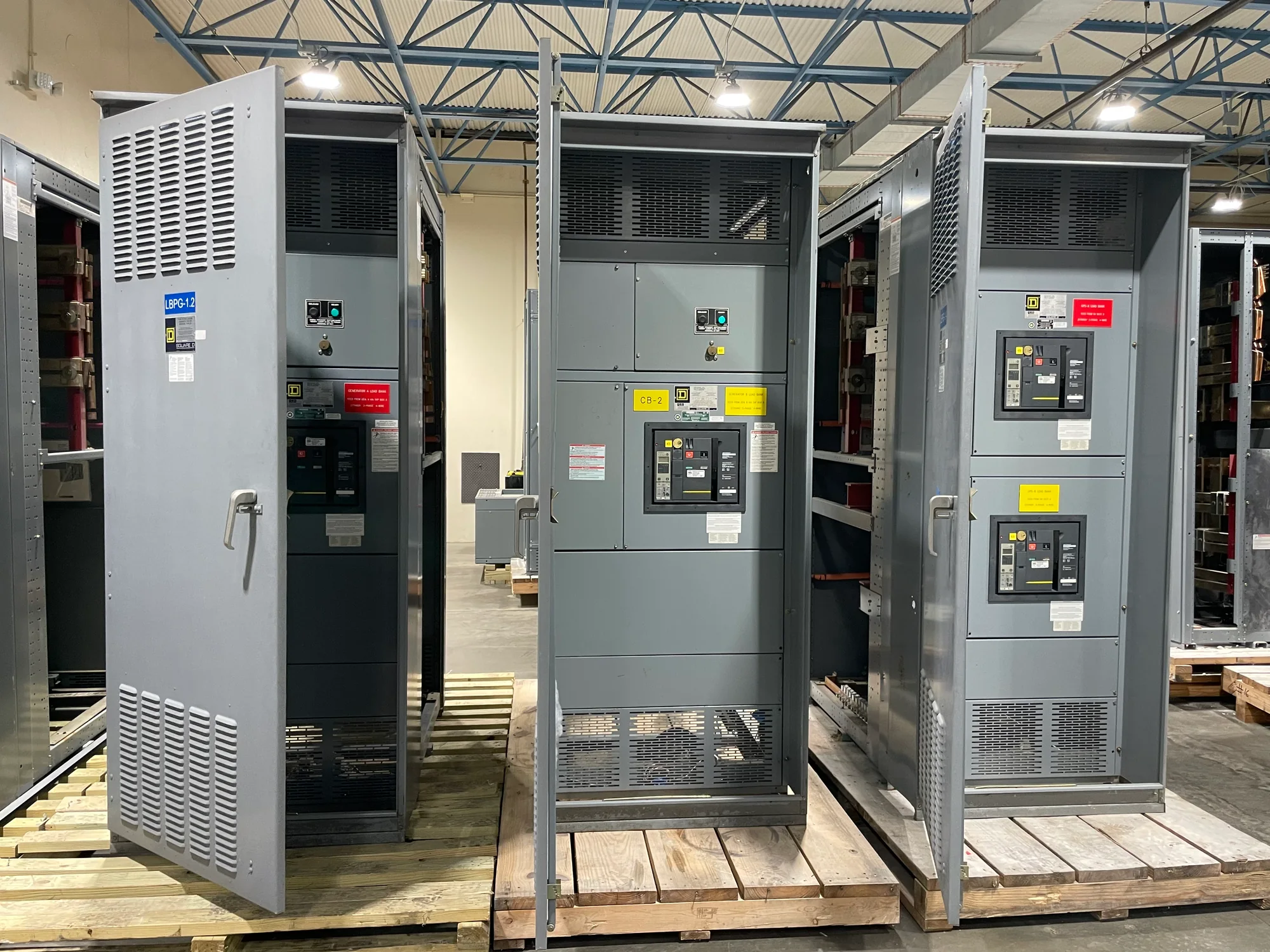
Start with the airport’s operating priorities
Airport motor control centers serve equipment whose interruption can affect passenger movement, staff operations or connected building systems. Begin by identifying each motor load, what it supports, and the operational consequence if it stops. Terminal ventilation, baggage handling, service-water pumps, loading equipment and transportation interfaces can have very different criticality and restart requirements. Group loads by function and location, then confirm which must remain available during maintenance or a fault elsewhere. This functional picture helps establish whether loads belong in separate sections, lineups or electrical sources, subject to the project design. It also informs spare capacity, maintainability and operating procedures. An airport’s continuity goals are not a substitute for a documented electrical design: qualified professionals must determine system architecture, protection, ratings and applicable codes. Early coordination among the owner, electrical engineer, facility operations and contractor can expose dependencies before equipment layout and procurement details are fixed.
Match starters and drives to the motors
Select motor-control methods from the driven equipment’s requirements rather than applying one approach across the lineup. Across-the-line starters may suit motors with straightforward starting and speed requirements, while adjustable-frequency drives can support variable-speed operation where the process and electrical design justify them. Evaluate motor nameplate data, load profile, acceleration time, starts per hour, required speed range and any process limits on stopping or restarting. Drives introduce considerations such as harmonics, heat dissipation, cable length and motor insulation compatibility; the engineering team should assess these against the installation and the wider distribution system. Confirm control voltage, local and remote commands, status indications, interlocks and interface responsibilities with the system integrator. Airport operations may require clear handoffs between automatic building controls and authorized local operation. Document intended behavior during loss and restoration of power, including which motors restart automatically, require operator action or remain inhibited.
| System | Voltage, phase, current and available fault current |
|---|---|
| Configuration | Lineup, protection, controls and enclosure as specified |
| Compliance | Applicable standards and listing confirmed for the assembly |
| Delivery | California and nationwide; schedule confirmed by quote |
Coordinate feeder protection and continuity
Feeder protection must account for the source, connected motor characteristics and the consequences of interruption. Gather available fault-current information, upstream device settings, conductor data, grounding arrangement and motor starting characteristics so the electrical engineer can evaluate equipment ratings and protection coordination. Selective coordination goals, where required by the project, need analysis across the relevant protective devices; they should not be assumed from component choices alone. Consider how a feeder fault could affect adjacent airport services and whether circuit grouping or source arrangements should limit the operational impact. For motors supplied through drives, confirm the protection approach with the drive and motor requirements, including any manufacturer-specific constraints. Short-circuit and coordination studies, labeling, settings documentation and commissioning checks can help ensure the installed design corresponds to the approved design. The project team should verify applicable codes and standards for the specific equipment and installation, and qualified professionals must establish safe work practices and protection settings.
Design for transportation-system interfaces
Airports connect terminals with systems such as people movers, parking facilities, service roads and other transportation infrastructure. A motor control center serving an interface should be designed around a clear boundary of responsibility: identify which equipment it feeds, where control authority resides, and which signals pass to another panel, building-management system or transportation controller. Agree on signal type, fail state, alarm meaning, communications method and ownership of interface wiring before construction. Define how permissives, emergency stops, status feedback and fault alarms behave across that boundary, and avoid relying on undocumented assumptions about another system’s logic. Where equipment is operated remotely, distinguish normal supervisory commands from local maintenance control and establish how access is secured. Review interface requirements with the airport, system vendor, controls contractor and electrical engineer, then capture them in drawings and point schedules. This reduces commissioning ambiguity and gives operations staff a usable record when troubleshooting integrated systems.
Plan access, installation and future service
Restricted access can shape an airport electrical project as much as the electrical design. Before finalizing dimensions or delivery plans, confirm the equipment room, route from receiving to installation, door and corridor clearances, floor loading, lifting points, working clearances and any security escort or work-window procedures. Construction in an operating terminal may require phased installation, temporary services, outage approvals and coordination with airport operations; define responsibilities and constraints early, without assuming a particular work window is available. Lay out operating handles, indicators and service areas for safe access, while accounting for adjacent equipment and room conditions. Provide maintainers with circuit identification, control documentation, spare-device strategy and a clear path to isolate equipment under approved procedures. Share project drawings, motor schedules, fault-current data, control narratives, interface details and site constraints with the manufacturer and design team. Schedule-sensitive or expedited options can be reviewed against scope, engineering and site requirements, but timing must be confirmed for the specific project.