Make the Immediate Area Safe
An emergency replacement begins with controlling the hazard, not moving directly to procurement. If equipment is smoking, arcing, unusually hot, making abnormal noise, or showing signs of water intrusion, keep people clear and follow the site’s emergency procedures. Do not open compartments or attempt operation unless directed by qualified personnel under the facility’s safety program. A qualified electrical professional should assess the condition, determine whether isolation is needed, and establish appropriate boundaries and protective measures. Fire response, utility coordination, and incident reporting may also be necessary, depending on what has occurred. Preserve useful information without exposing staff to danger: note alarms, affected loads, visible damage from a safe location, and the sequence of events. This first assessment helps distinguish a localized problem from damage that may affect connected equipment or the wider distribution system, and it provides a safer basis for deciding what must happen next.
Stabilize Service With a Temporary-Power Plan
Temporary power can help maintain critical functions while damaged equipment is evaluated and replacement is planned, but it is not an automatic or risk-free substitute. Identify which loads are essential, which can be curtailed, and what interruption each can tolerate. Qualified professionals should determine whether a generator, temporary switchboard, alternate feeder, or other arrangement is suitable, then assess available fault current, grounding, overcurrent protection, transfer method, cable routing, and environmental exposure. The plan must account for safe isolation of damaged gear and prevent unintended backfeed into utility or facility circuits. Confirm connection points, physical access, ventilation, fuel or operating needs, and who is authorized to operate the temporary system. Document operating limits and procedures, including how the site will transition from temporary service to permanent equipment. A carefully bounded interim arrangement can reduce disruption while keeping life safety and electrical hazards central to decisions.
| System | Voltage, phase, current and available fault current |
|---|---|
| Configuration | Lineup, protection, controls and enclosure as specified |
| Compliance | Applicable standards and listing confirmed for the assembly |
| Delivery | California and nationwide; schedule confirmed by quote |
Define the New Replacement Equipment
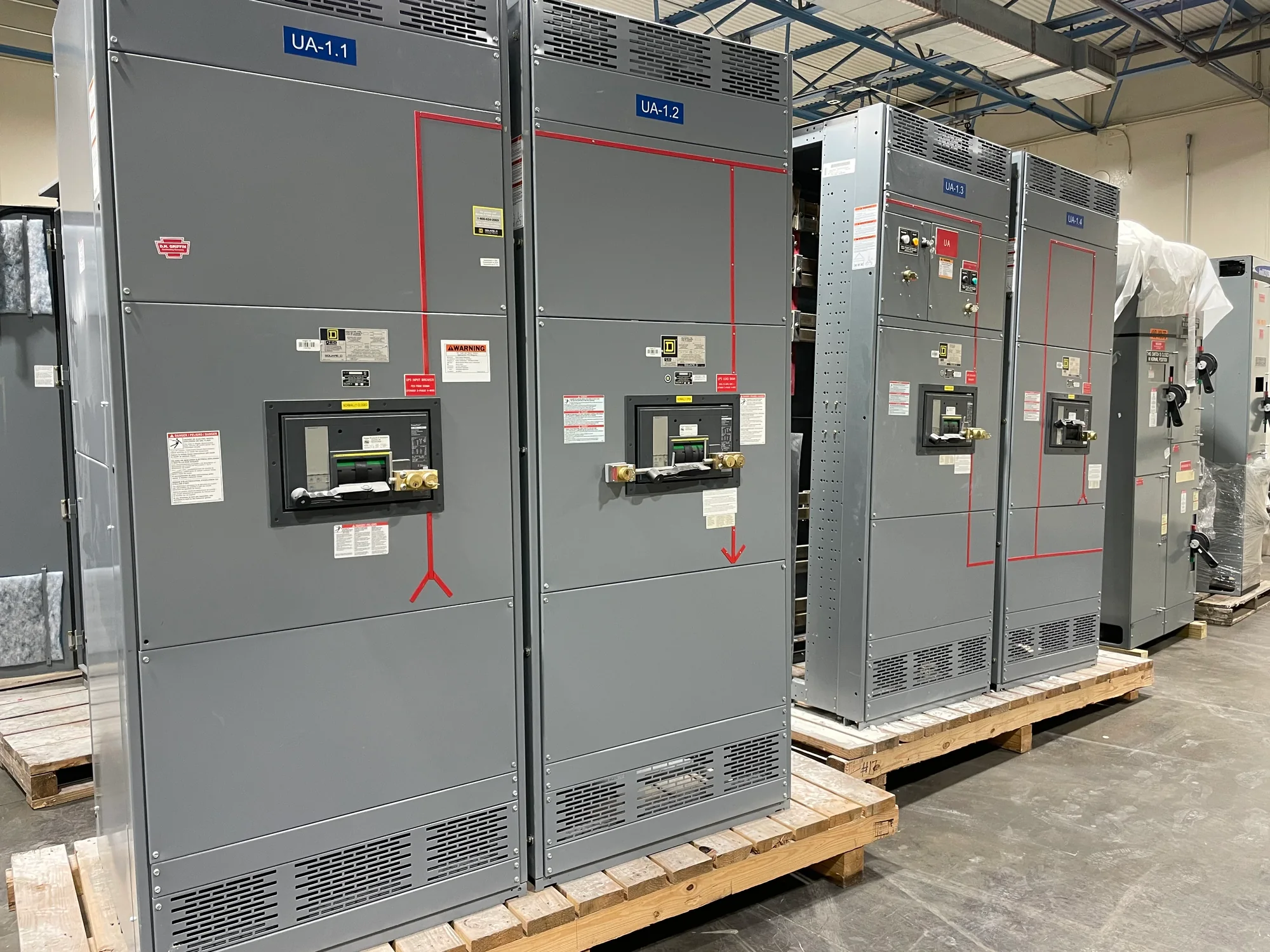
A replacement assembly must fit the electrical system and the physical installation; matching the old nameplate alone may not be enough, particularly after a fault or system modification. Gather photographs and nameplate details only when they can be obtained safely, along with one-line diagrams, available fault-current information, system voltage and frequency, grounding arrangement, bus requirements, feeder and main-device data, enclosure conditions, and dimensions. Record cable entry direction, termination space, access constraints, and any changes to loads or utility service. The project team should identify applicable codes and standards for the specific equipment, plus required ratings, protection coordination, and interface needs. Qualified professionals determine these requirements for the installation. Switchgear Builder California builds new equipment in the USA with American components; project-specific construction and suitability must be reviewed against the documented application. Clear inputs allow engineering review to identify open questions before an order scope is finalized.
Coordinate Replacement and Cutover
Replacement is a site integration effort as much as an equipment decision. Establish who owns the electrical design, field verification, installation, testing, utility coordination, permits, and authorization to energize. Compare the proposed equipment arrangement with existing feeders, protective devices, grounding, control wiring, and downstream loads. Plan removal and access routes, lifting needs, working clearances, temporary support, and any building or infrastructure changes. The cutover sequence should define isolation, verification of absence of voltage, connection checks, testing, and controlled return to service, with responsibilities assigned to qualified personnel. Consider how the site will manage load shedding and communicate outages to occupants or operations teams. If the event damaged adjacent gear, cables, transformers, or controls, include inspections and corrective work in the recovery scope rather than assuming only the visibly failed assembly needs attention. A coordinated plan reduces avoidable surprises and helps keep safety, technical compatibility, and operational priorities aligned.
Confirm Response and Availability Directly
For an urgent inquiry, provide the known equipment data, site location, failure description, immediate safety status, temporary-power approach, required configuration, and the date by which the site needs a decision. Include drawings and photographs only if they can be shared safely, and identify uncertainties rather than filling gaps with assumptions. Ask for confirmation of whether the request can be reviewed, what additional engineering information is needed, and whether schedule-sensitive or expedited options may be considered. Response, equipment availability, and timing depend on project scope, design review, components, and current production commitments; they should be confirmed directly and are not guaranteed. California customers and projects elsewhere in the United States can discuss requirements and shipping considerations with the manufacturer, subject to project review. Before proceeding, align on scope, responsibilities, commercial terms, and the steps required to release new equipment for engineering and production. Prompt, complete information supports a useful review without substituting urgency for verification.