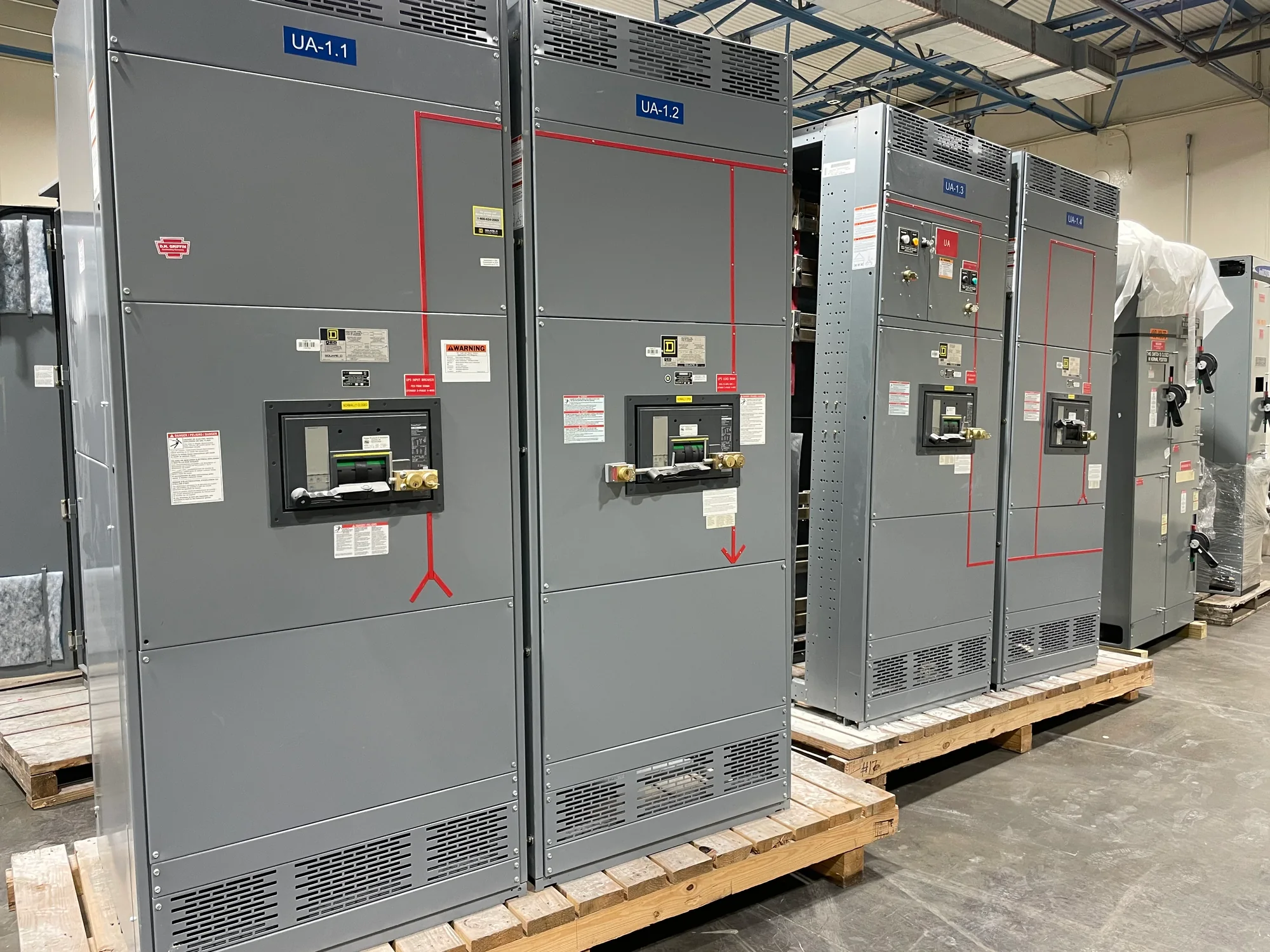
What a Main Breaker Is
A main breaker is the principal circuit breaker at an equipment supply point. In switchgear, it is commonly positioned where incoming power enters an assembly, ahead of distribution sections and outgoing feeder devices. Its central role is to open or close the incoming circuit and, when equipped and coordinated for the application, interrupt specified overcurrent conditions. Opening the main can de-energize downstream equipment supplied through that point, but it does not necessarily isolate every source or remove all electrical hazards. A system may have multiple utility feeds, generators, energy storage, control power, or backfeed paths that remain energized after the main opens. The term describes a function and location in a power system, not a single breaker design or a guaranteed set of features. Engineers should read the one-line diagram and equipment documentation to determine exactly which circuit the device controls.
Main Breaker Versus Feeder Breakers
The distinction between a main breaker and feeder breakers is primarily their place in the distribution hierarchy. The main protects and switches a circuit at the supply point for an assembly or section; feeder breakers control and protect individual downstream circuits serving loads, panels, transformers, or other equipment. Not every switchgear lineup uses the same arrangement: a project may call for a main device, multiple mains, a tie breaker, or a configuration without a main breaker at a particular lineup. The one-line diagram establishes how these devices relate. Their functions also need to be coordinated. If a downstream fault occurs, the design team generally evaluates whether the feeder device should clear it before an upstream main trips, while preserving the required protection for faults closer to the source. The correct outcome depends on system conditions, protective-device settings, and applicable requirements—not simply on which breaker is physically largest.
| System | Voltage, phase, current and available fault current |
|---|---|
| Configuration | Lineup, protection, controls and enclosure as specified |
| Compliance | Applicable standards and listing confirmed for the assembly |
| Delivery | California and nationwide; schedule confirmed by quote |
Protection, Interrupting Duty, and Coordination
Selecting a main breaker begins with electrical system data, not a nominal current value alone. The design team evaluates the circuit voltage, continuous load, available fault current at the installation point, and the breaker’s applicable ratings and characteristics. Interrupting capability must be appropriate for the calculated fault duty, and the assembly’s ratings and construction must be suitable for the intended application. Protection may involve adjustable trip functions, ground-fault considerations, or other provisions, but their suitability and availability must be confirmed for the specific design. Coordination studies assess how the main interacts with feeder devices and upstream protection; changes in source capacity, transformer impedance, conductor length, or utility contribution can change fault levels and settings. Qualified professionals determine protection, ratings, and applicable codes for each project. For medium- or high-voltage equipment, identify and verify the standards applicable to that specific equipment rather than assuming low-voltage switchboard standards govern it.
Operating and Isolation Considerations
A main breaker provides a means to switch its circuit and may serve as part of an isolation procedure, but the word “main” does not make it a complete safety boundary. Before work, qualified personnel must identify all energy sources, follow the site’s approved de-energization and lockout/tagout procedures, verify absence of voltage with appropriate methods, and account for stored energy and possible backfeed. The breaker’s operating mechanism, indication, control circuit, interlocks, and any remote operating provisions should be considered as parts of the project design. These details affect how operators understand the device’s state and how switching is carried out under site procedures. A breaker open indication alone is not proof that all conductors or adjacent sections are safe to work on. The project’s equipment layout, operating practices, and safety requirements should determine whether additional disconnecting means, barriers, or procedures are needed.
Information to Provide When Specifying One
For a useful design review, provide the current one-line diagram, system voltage and frequency, source information, transformer data, estimated available fault current, load details, and the required arrangement of mains, ties, and feeders. Identify the installation environment, operating sequence, grounding approach, metering or protective functions, control-power expectations, and any project specifications or governing standards. If replacement or modernization is being considered for equipment the customer owns, provide existing nameplate data, drawings, photographs, and known field constraints so qualified reviewers can assess the scope; the existing device’s dimensions or rating alone do not establish compatibility. For new equipment, the manufacturer can use complete project inputs to review a proposed configuration and identify items needing confirmation. California projects and customers elsewhere in the United States can discuss requirements and shipping considerations during project review. Schedule-sensitive options, if considered, depend on scope and review and are not guaranteed. Clear inputs reduce assumptions and help align the main breaker with the full distribution system.