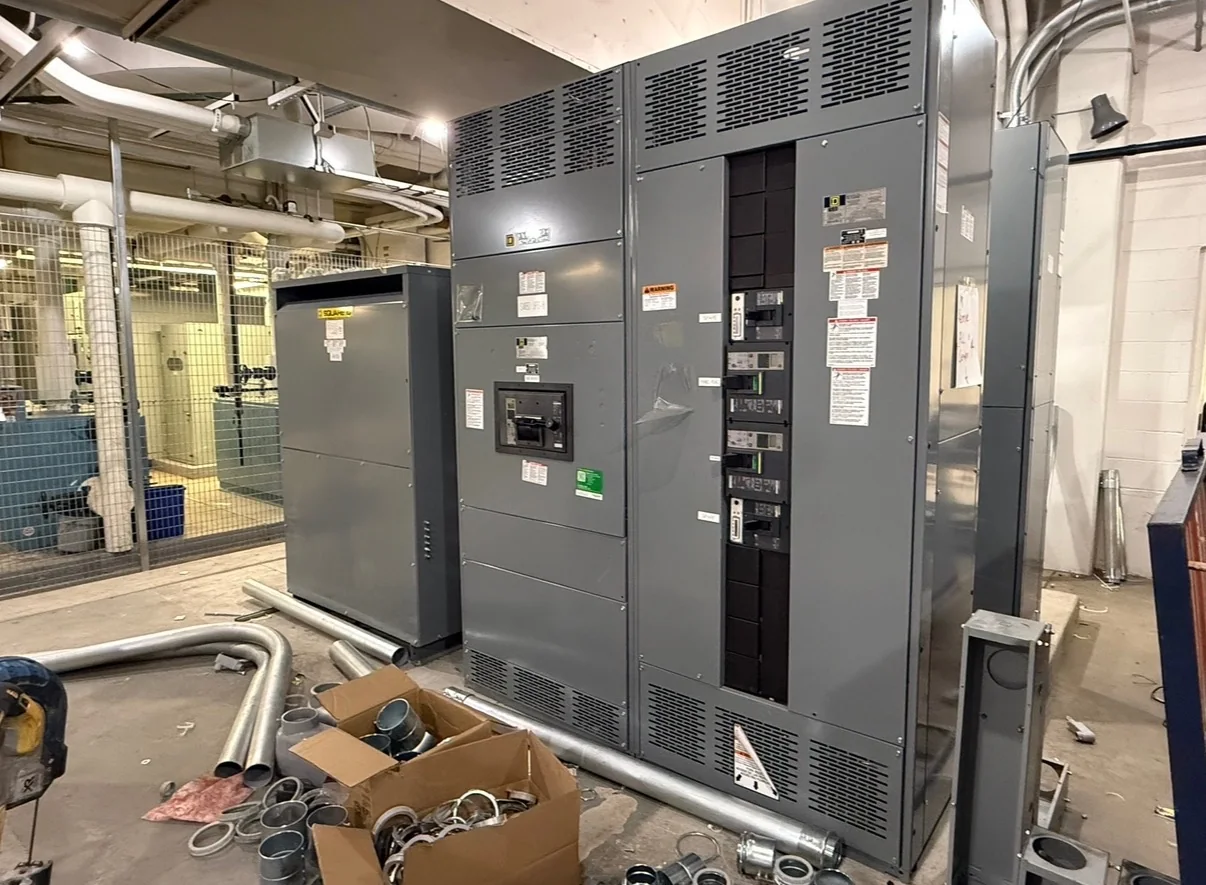
What a busbar is
A busbar is a conductive element used to collect electrical power at one point and distribute it to multiple circuits or equipment sections. In switchgear, busbars form part of the internal power path between incoming connections, switching devices, protective devices, and outgoing feeders. Depending on the design, a busbar may be a rigid bar, a formed conductor, or a group of conductors arranged together. Copper and aluminum are common conductor materials, but material selection is only one part of the engineering decision. The busbar’s shape, cross-section, spacing, supports, joints, and enclosure all affect how it performs. Unlike a cable, which is typically routed as an insulated flexible conductor, a busbar is commonly integrated into the equipment’s structure. The term describes its electrical function; it does not, by itself, specify a current rating, voltage class, construction, or approval.
How busbars distribute power
The busbar provides a common electrical connection from which current can flow to connected circuits. In a three-phase assembly, separate phase busbars carry the respective phase conductors, while neutral and grounding conductors may be provided where the system design requires them. A main bus can connect incoming power to several feeder devices, and sectionalized arrangements can divide the assembly into zones. Bus ties or other switching arrangements may allow sections to be interconnected, separated, or supplied in different ways, subject to the one-line diagram and operating plan. These choices affect continuity, isolation, and how faults or maintenance activities are managed. A busbar is not itself a protective device: breakers, fuses, relays, and associated controls perform protection and switching functions. Qualified professionals must coordinate those devices with the system and determine safe operating procedures for the equipment.
| System | Voltage, phase, current and available fault current |
|---|---|
| Configuration | Lineup, protection, controls and enclosure as specified |
| Compliance | Applicable standards and listing confirmed for the assembly |
| Delivery | California and nationwide; schedule confirmed by quote |
Material, geometry, and connections
Conductor material and geometry influence electrical resistance, heat generation, weight, fabrication, and connection details. Copper generally offers higher conductivity by volume than aluminum, while aluminum can provide a lower-weight option; the comparison must account for the complete assembly and its requirements rather than material cost alone. Cross-sectional area, bar thickness, width, and arrangement contribute to current-carrying performance, but no single dimension establishes a suitable rating. Engineers also consider operating temperature, enclosure conditions, ventilation, ambient environment, and the effects of nearby conductors. Joints deserve particular attention because contact pressure, surface preparation, fastener selection, and assembly quality affect resistance and heating. Different metals or finishes at a connection may require specific design measures. The equipment design should define interfaces clearly, including termination locations and conductor size ranges, so incoming cables, outgoing feeders, and field connections can be coordinated.
Electrical and mechanical design checks
Busbar design must address more than continuous current. During a short circuit, large electromagnetic forces can act between conductors and between conductors and supports. The assembly’s bracing, spacing, fastening, and enclosure arrangement therefore need evaluation for the applicable fault conditions. Insulation clearances, barriers, phase separation, and access also matter, especially where maintenance or operation could expose personnel to electrical hazards. Voltage, frequency, grounding method, available fault current, protective-device characteristics, and the intended duty are project inputs that influence design and coordination. Temperature rise and heat dissipation require attention alongside the impact of connected equipment and installation conditions. Applicable codes and standards depend on equipment type and project requirements; UL 891 applies to applicable low-voltage switchboards, not to all switchgear. For medium- or high-voltage equipment, identify and verify the standards applicable to that specific equipment. Qualified professionals determine ratings, protection, and code requirements.
Information to provide for a project
When discussing a new switchgear assembly, provide the one-line diagram, nominal system voltage, phase and wire configuration, frequency, grounding approach, and required continuous current. Include available short-circuit current or the specified fault-duty basis, the protection scheme, incoming and outgoing connection details, and any required bus sectionalizing or tie operation. Identify the installation environment, space constraints, cable entry direction, conductor material preferences, and interfaces with transformers, generators, utility connections, or downstream equipment. Note applicable project specifications and the standards that the design must address, along with any operational, maintenance, or future expansion considerations. Clear inputs help the manufacturer assess the bus arrangement and identify questions before design decisions are finalized. For Switchgear Builder California, share these project details when requesting a review of new equipment. The engineering team can clarify requirements and discuss feasible design considerations, with final ratings and configuration subject to project review.