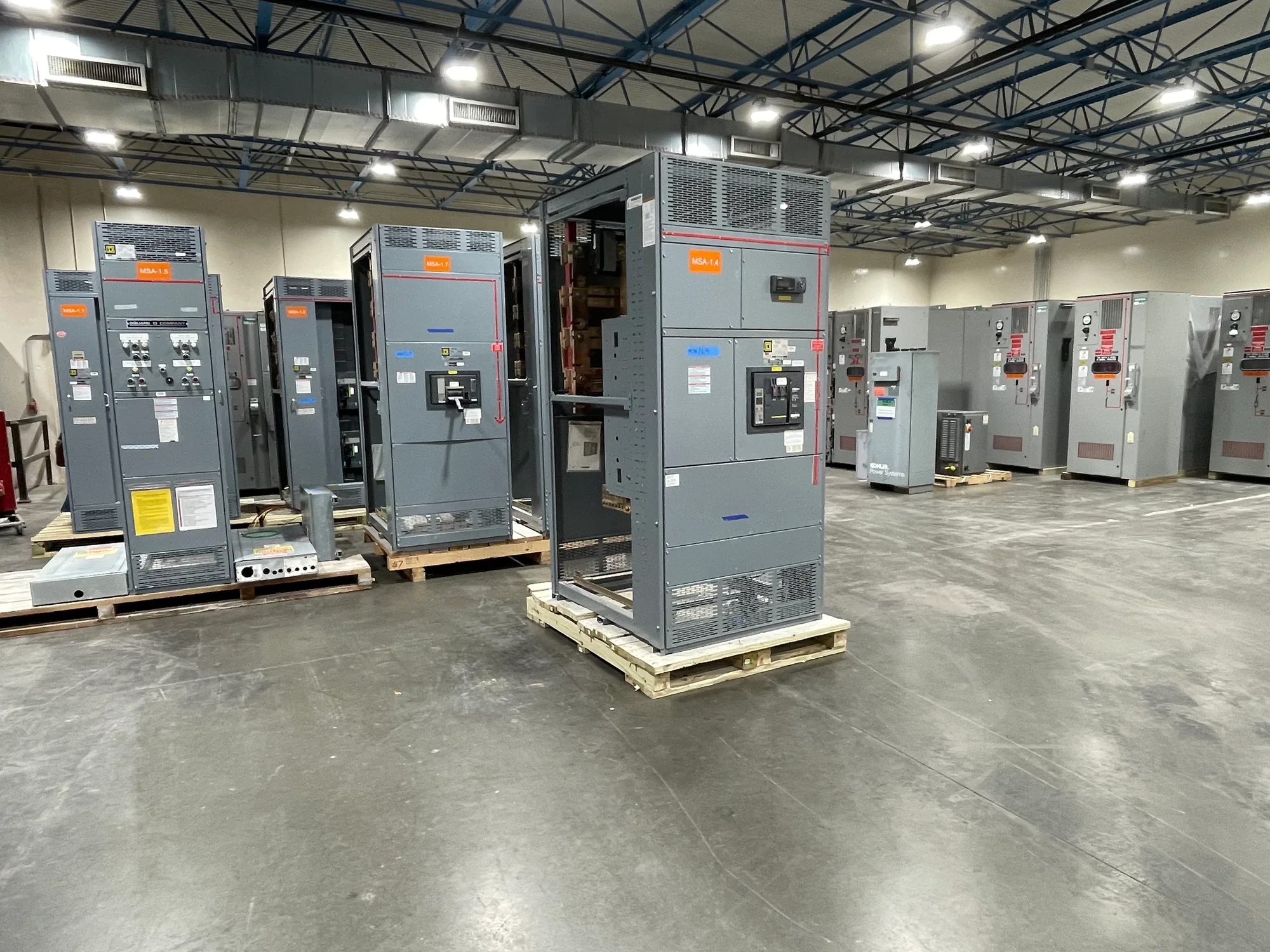
Start with the plant’s operating priorities
Industrial low-voltage switchgear is part of the plant’s operating strategy, not just a collection of breakers. Begin by identifying which processes must remain available, which can tolerate interruption, and how a fault in one area could affect production elsewhere. Map major loads, normal and alternate sources, planned expansions, and the distribution paths feeding critical equipment. This helps establish the lineup arrangement and the degree of separation or redundancy worth evaluating. Continuity goals should be balanced against complexity: additional sections, ties, or alternate paths can support operating flexibility, but they also introduce switching procedures, interlocks, protection coordination work, and maintenance obligations. Define how operators expect to isolate a section and restore service after a disturbance. A one-line diagram, load information, operating scenarios, and known future projects give the design team a practical starting point. Qualified professionals should validate system architecture and safety requirements for the actual installation.
Shape breaker lineups around real loads
A useful breaker lineup reflects both the electrical characteristics and the operational role of each feeder. For industrial plants, that means distinguishing motor feeders from distribution feeders and identifying large motors, frequent starts, variable-speed drives, transformers, and other loads that may affect current profiles or power quality. Provide equipment ratings, starting methods, duty cycles, expected simultaneous operation, and available fault-current information where known. These inputs support evaluation of breaker frame and trip requirements, interrupting ratings, and coordination with upstream and downstream devices; they do not substitute for a complete engineering study. Grouping circuits by process area or operating function can make identification and isolation more intuitive, while leaving suitable room for future circuits may reduce disruptive changes later. Available space, cable entry, conductor routing, and access for testing also influence lineup layout. Confirm the applicable system voltage, frequency, grounding arrangement, environmental conditions, and project-specific code requirements before finalizing the design basis.
| System | Voltage, phase, current and available fault current |
|---|---|
| Configuration | Lineup, protection, controls and enclosure as specified |
| Compliance | Applicable standards and listing confirmed for the assembly |
| Delivery | California and nationwide; schedule confirmed by quote |
Coordinate protection to limit process disruption
Protection should clear faults safely while avoiding unnecessary trips that take unaffected plant loads offline. Selectivity and coordination depend on the complete system, including utility or generator sources, transformers, feeder impedance, motor contribution, and protective devices beyond the switchgear. A short-circuit and coordination study can help assess whether proposed breaker settings distinguish downstream faults from upstream events; arc-flash analysis addresses a separate safety question and should not be treated as a byproduct of coordination. For critical processes, review how a feeder fault, bus event, loss of a source, or transfer operation affects the production sequence and restart requirements. Adjustable trip functions and settings may offer flexibility, but settings must be supported by engineering analysis, equipment limits, and the approved protection philosophy. Provide current one-line diagrams, source data, transformer information, motor details, and existing device settings when available. Qualified professionals determine protection, ratings, and applicable codes for each project, then document settings and operating responsibilities clearly.
Design for industrial conditions and service access
Industrial operating environments can challenge equipment through heat, dust, moisture, vibration, corrosive contaminants, or limited working space. Describe where the lineup will be installed, the surrounding process conditions, ventilation, elevation, and any washdown or contamination concerns. These details inform enclosure and construction discussions, but the suitable design must be confirmed for the site and its governing requirements. Maintainability deserves equal attention. Operators and technicians need appropriate access to identify devices, inspect connections, perform approved testing, and isolate equipment safely. Consider working clearances, door swing, cable access, lifting and handling routes, lighting, and whether routine work can be performed without interrupting adjacent processes. Maintenance procedures and manufacturer documentation should align with the actual equipment configuration; safe work practices and required protective measures remain the responsibility of qualified personnel. Share facility drawings and access constraints early, especially for replacement or expansion projects where existing structures and live operations can limit installation options.
Prepare a focused project package
A complete project package helps translate plant priorities into a reviewable switchgear design. Include the latest one-line diagram, load schedule, available fault-current data, source and transformer details, feeder and motor information, protection requirements, and operating sequence. Note whether the work is new distribution, capacity expansion, or replacement, and identify interfaces with existing equipment, controls, generators, or transfer schemes. Specify the installation environment, preferred cable entry, space limitations, access requirements, and anticipated future circuits. Identify applicable standards and codes for the particular equipment and jurisdiction; UL 891 applies to applicable low-voltage switchboards, not automatically to every low-voltage or higher-voltage assembly, and a standards reference does not itself establish a third-party listing. Ask the manufacturer to clarify assumptions, exclusions, required studies, and information still needed for engineering review. For schedule-sensitive projects, raise milestones and constraints early; any expedited approach depends on project scope and review. Switchgear Builder California builds new equipment in the USA with American components and serves California and nationwide customers.