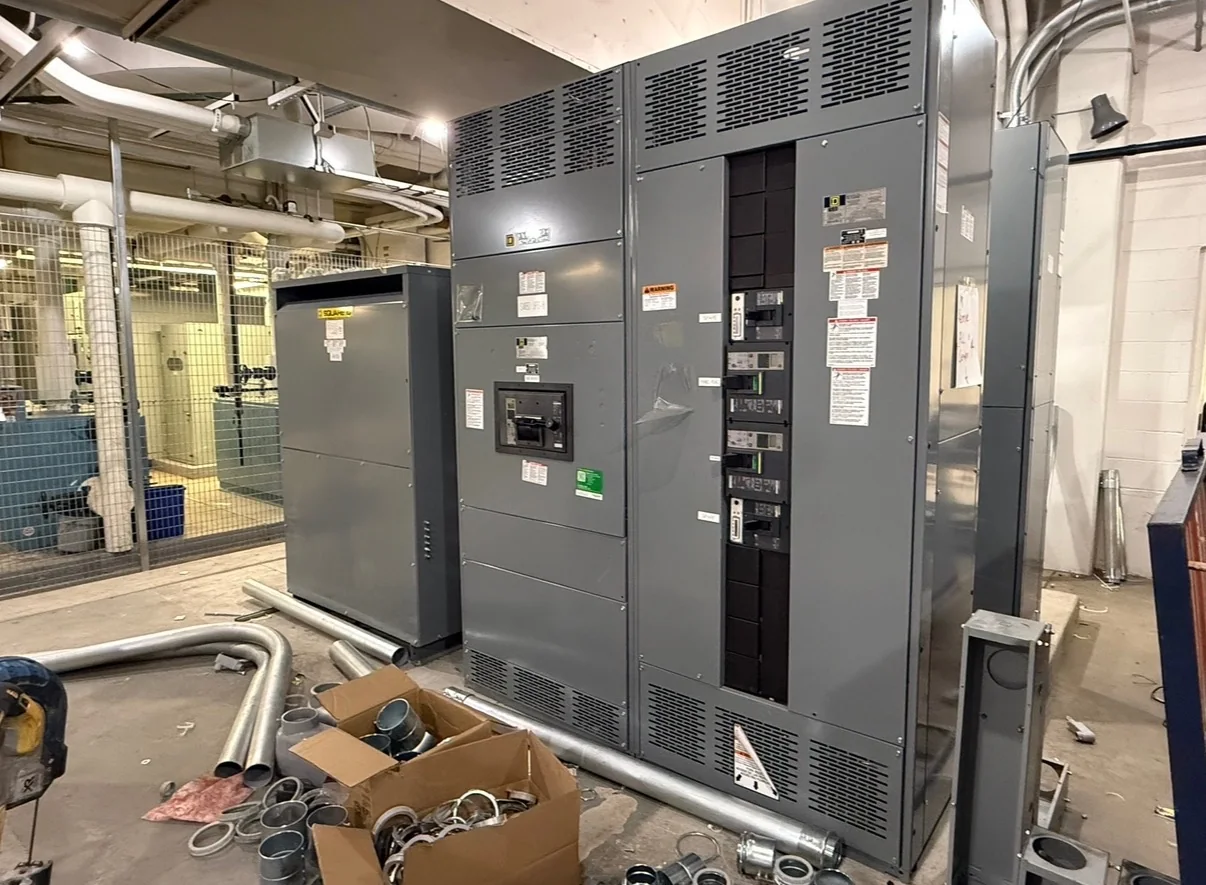
Start with the existing equipment record
Replacing switchgear begins with identifying what is installed and what the project must accomplish. Record the manufacturer, equipment type, model or catalog information, serial number, year, and any nameplate ratings that are legible. Photograph each nameplate and the full assembly, including sections, doors, barriers, cable compartments and visible labels. Gather available one-line diagrams, wiring diagrams, prior modification records and maintenance documentation; note when drawings do not match the installed equipment. The existing gear is useful evidence, but its original design may not satisfy present loads, operating plans or project requirements. Establish whether the replacement must preserve an existing electrical arrangement or accommodate changes to the system. A qualified electrical professional should review the records and identify missing or uncertain information before equipment is specified. This creates a sound basis for comparing new gear without treating an old label as a complete design brief.
Compare ratings and system requirements
Nameplate data can help identify voltage, current and interrupting or withstand ratings, but each value must be checked against the actual system and the intended application. Confirm the available fault current, grounding method, frequency, load characteristics, source configuration and protective-device coordination requirements using current project information. A replacement may need different ratings or a revised arrangement if the system has changed since the original equipment was installed. Capture breaker or switch details, bus ratings, trip-unit information and control power requirements where applicable, while distinguishing verified data from assumptions. Protection, ratings and applicable codes must be determined by qualified professionals for the specific installation. For medium- or high-voltage equipment, identify and verify the standards applicable to that particular equipment rather than relying on low-voltage switchboard terminology. Clear, validated inputs allow the manufacturer and project team to evaluate a suitable new assembly and flag consequential differences early.
| System | Voltage, phase, current and available fault current |
|---|---|
| Configuration | Lineup, protection, controls and enclosure as specified |
| Compliance | Applicable standards and listing confirmed for the assembly |
| Delivery | California and nationwide; schedule confirmed by quote |
Measure the installation, not just the cabinet
Physical fit is often more complex than matching the overall enclosure width and height. Measure the complete lineup and individual sections, including depth, elevations, mounting points, door swing, clearances, cable-entry space and access routes for installation. Record the location and orientation of incoming and outgoing connections, bus duct, conduit, trenches and overhead obstructions. Note floor conditions, anchoring details, wall proximity, ventilation needs and any restrictions on moving equipment through the building. Dimensions should be taken from reliable site measurements where possible and compared with existing drawings; indicate measurement points and uncertainties. Also consider working clearances, service access and code requirements, which qualified professionals must evaluate for the site. A replacement lineup may not duplicate the old footprint exactly, and a small dimensional difference can affect cables, terminations or construction sequencing. Early field verification helps reveal whether the project needs layout changes or additional installation planning.
Define what must remain compatible
A replacement project often involves connections and interfaces beyond the switchgear enclosure. Document conductor sizes and termination types, phase arrangement, bus connections, grounding provisions, control wiring, metering, interlocks, communications and auxiliary circuits that must be retained or revised. Identify equipment upstream and downstream, including transformers, generators, transfer equipment and protective devices, so the new design can be assessed in its full system context. Compatibility does not necessarily mean copying every existing feature: the project may benefit from updated protection, monitoring or operating functions, while changes can affect drawings, controls, coordination and commissioning. List essential functions separately from preferences, and identify who will provide interface details and approve design decisions. Where legacy information is unavailable, plan for inspection or engineering review rather than assuming a connection based on appearance. This functional comparison helps keep the replacement scope clear and reduces the risk of late changes during fabrication or field installation.
Prepare a useful request for replacement gear
When requesting a proposal for new switchgear, provide the verified nameplate photographs, measured dimensions, one-line diagram, available fault-current information, load data, connection details, site constraints and required functions. Mark each item as confirmed, estimated or still under review, and include the project location, installation conditions and desired schedule for evaluation. Ask the supplier to identify information gaps, describe proposed deviations from the existing arrangement and clarify what engineering documents are needed for review. Requirements for standards, environmental conditions, seismic considerations, enclosure type and interfaces should be stated where known and confirmed for the application. Switchgear Builder California builds new equipment in the United States with American components and supplies customers in California and nationwide. Schedule-sensitive or expedited possibilities can be discussed subject to project review; no timing should be assumed before scope and requirements are evaluated. A complete, transparent package supports a more meaningful comparison and a practical path from existing equipment records to a defined replacement design.