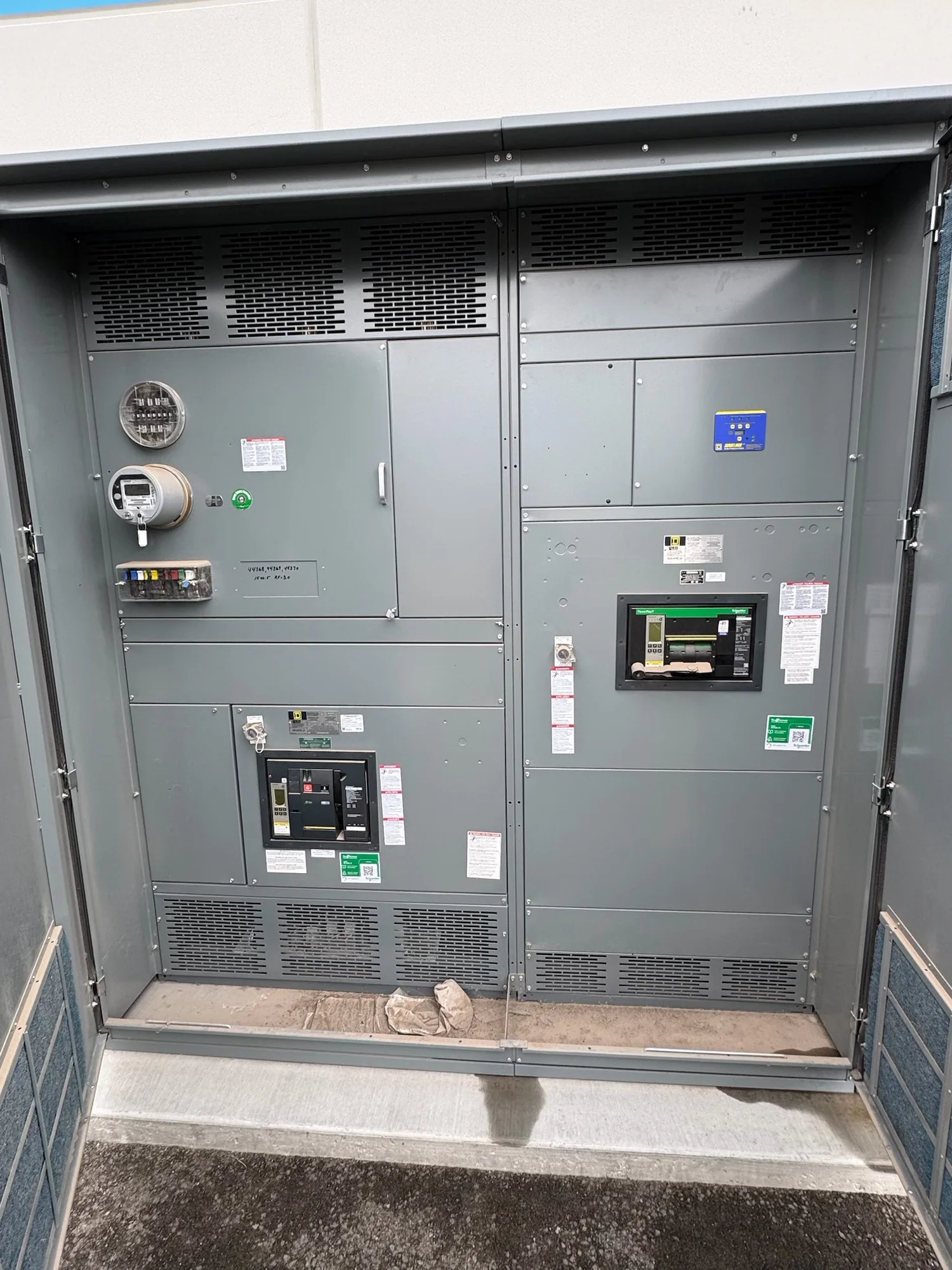
Confirm the Supply Before Choosing Equipment
Phase configuration describes how alternating-current power is delivered, and it is a foundational input to switchgear design. A single-phase source and a three-phase source are not interchangeable simply because their voltage labels appear similar. Begin with the one-line diagram and utility or upstream equipment documentation, then confirm the nominal voltage, frequency, grounding arrangement, and available conductors with the project’s electrical engineer. Record whether the service is single-phase or three-phase and whether a neutral is required. In facilities with transformers, generators, or multiple service sections, verify the configuration at the actual point where the new assembly will connect; the source elsewhere in the building may differ. Resolving ambiguity at this stage helps prevent mismatches in bus arrangement, protective devices, and outgoing circuits. Qualified professionals should establish the design basis and confirm applicable codes and safety requirements for the installation.
Match Poles to the Circuit and Switching Duty
Pole count must follow the circuit’s conductors and the required switching and protection scheme, rather than a general assumption based on phase alone. A single-phase circuit may use two current-carrying conductors, or a line and neutral arrangement, depending on its voltage and grounding system. Three-phase circuits commonly use three phase conductors, with a neutral included when the connected loads or system design call for one. Whether a neutral is switched is a separate engineering decision that depends on the grounding method, transfer arrangement, and applicable requirements. Also distinguish the number of poles in a protective device from the number of bus phases and from the conductor count. Provide the intended circuit diagrams, load types, fault-current information, and switching function when requesting a specification. The engineer can then coordinate device poles and ratings with the system, rather than treating a catalog description as a complete design.
| System | Voltage, phase, current and available fault current |
|---|---|
| Configuration | Lineup, protection, controls and enclosure as specified |
| Compliance | Applicable standards and listing confirmed for the assembly |
| Delivery | California and nationwide; schedule confirmed by quote |
Specify Bus for the Actual Phase Arrangement
Bus configuration follows the electrical system being served. Three-phase distribution requires bus paths arranged for the three phase conductors, while a neutral bus may be needed for line-to-neutral loads. Single-phase assemblies require a different conductor arrangement, and their bus dimensions and connections must be based on the specified voltage, continuous load, fault duty, and physical layout. Do not assume that an assembly can be converted between phase configurations by changing a breaker or adding a conductor; bus geometry, insulation clearances, barriers, terminals, and enclosure layout may all be affected. Give the builder the source configuration, bus material preference if established by the project, required ampacity, short-circuit design inputs, and incoming and outgoing connection details. Confirm whether future spaces or expansion capacity are required, since reserve provisions can influence the section layout. Ratings and construction details remain subject to engineering review against project conditions.
Check Connected Loads and Distribution Needs
The loads determine whether the selected supply configuration is practical, and their mix can be more important than the building’s general description. List motors, heaters, lighting, electronic loads, and other major equipment with nameplate voltage, phase, current, starting or inrush characteristics, and operating duty where available. A three-phase source may serve three-phase motors while also supplying single-phase branch loads through an appropriate distribution arrangement. A single-phase service cannot directly supply equipment that requires three-phase power; any conversion or separate source must be evaluated as part of the wider electrical design. Consider load balance, neutral current, harmonics, growth, and coincident demand where relevant. For a replacement or new installation, compare the equipment schedule with the one-line diagram and flag discrepancies before the switchgear is finalized. This gives the design team a clearer basis for feeder allocation, protective coordination, and connection planning.
Provide a Complete Basis for Specification
A useful request for quotation or design review identifies the phase configuration and voltage at the switchgear connection, frequency, grounding method, neutral requirements, system fault-current data, and the intended pole arrangement. Include an updated one-line diagram, load schedule, protective-device requirements, enclosure and environmental conditions, cable or busway entry direction, and space constraints. State whether the project involves a new service, a distribution change, or equipment coordinated with existing gear; for existing interfaces, provide verified drawings and field dimensions rather than relying on assumptions. Identify the governing project specifications and standards applicable to the particular equipment. UL 891 applies to applicable low-voltage switchboards; its relevance does not establish a listing or determine requirements for medium- or high-voltage equipment. For those systems, confirm the standards and ratings specific to the equipment and jurisdiction. Switchgear Builder California supplies new equipment built in the USA with American components. Share the design inputs early so the team can review fit, coordination, and any schedule-sensitive options without assuming availability or timing.