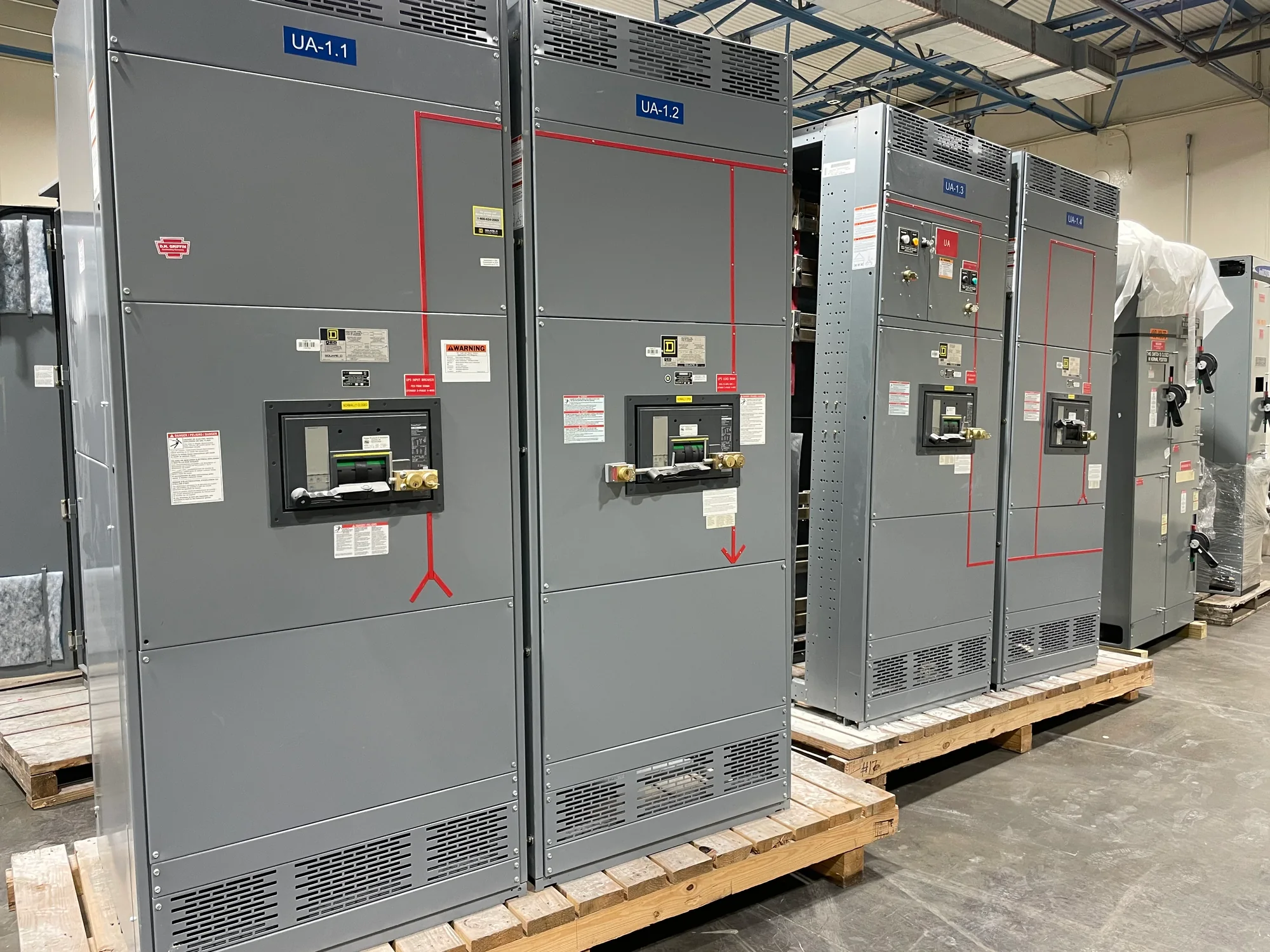
Understand the 120/208 V Grounded-Wye Service
A 120/208 V service commonly uses a three-phase, four-wire grounded-wye configuration. The nominal 120 V value describes the voltage from any phase conductor to neutral; 208 V is the nominal voltage between two phase conductors. This distinction affects how the service is distributed and how loads are connected. A project’s actual service arrangement must be confirmed from utility information and electrical documents rather than assumed from a panel label or building description. Identify the number of phases and wires, the neutral arrangement, grounding and bonding details, and the available fault current where required for design. Existing facilities may contain multiple services or distribution systems with different characteristics. Confirming the source configuration early gives the manufacturer a reliable basis for developing equipment to the project requirements and helps the design team avoid mismatches among the service, distribution equipment, and downstream loads.
Separate Phase-to-Neutral and Phase-to-Phase Loads
At a 120/208 V grounded-wye service, a load connected from one phase to neutral is supplied at nominally 120 V, while a load connected across two phases is supplied at nominally 208 V. Single-phase loads may be distributed across the available phase conductors, and three-phase loads use the phase-to-phase system as their design requires. Do not treat the service voltage as a single value that applies identically to every circuit. Provide a current load schedule showing each load’s voltage, phase, poles, connection, and relevant demand information. Note equipment that requires a neutral, such as applicable line-to-neutral loads, and identify any three-phase loads or controls with specific voltage requirements. A balanced allocation of line-to-neutral loads can help manage phase loading, but the engineer must evaluate actual operating conditions and applicable code requirements. Clear circuit information supports practical equipment selection and coordination.
| System | Voltage, phase, current and available fault current |
|---|---|
| Configuration | Lineup, protection, controls and enclosure as specified |
| Compliance | Applicable standards and listing confirmed for the assembly |
| Delivery | California and nationwide; schedule confirmed by quote |
Confirm Ratings for Each Assembly and Device
The nominal service description alone does not establish the ratings of a proposed switchgear or distribution assembly. Confirm the assembly’s rated voltage and the voltage rating and application of each included or specified device, including breakers, switches, metering components, control power equipment, and other connected apparatus. Check that the device is suitable for the intended phase-to-neutral or phase-to-phase connection, number of poles, and system grounding arrangement. Also provide the required continuous current, interrupting or withstand criteria, and available fault-current information for qualified project review; these are separate design considerations from nominal voltage. Equipment that serves more than one voltage or system should be described by circuit and function so that each application can be evaluated. Qualified professionals determine protection, ratings, and applicable codes for the project. Recording these requirements on the one-line diagram and schedules helps prevent assumptions during quotation, design review, and installation.
Coordinate Distribution, Protection, and Documentation
A complete specification ties the service conditions to the distribution plan and the loads it supplies. Share the latest one-line diagram, panel or feeder schedules, load information, service data, and any project requirements for enclosure, access, metering, control, or future expansion. Identify the location and purpose of each section and feeder, along with upstream and downstream protective devices. Protection and coordination depend on available fault current, conductor and equipment characteristics, and the project’s operating objectives; a 120/208 V label does not establish an appropriate protective-device selection. Where line-to-neutral and line-to-line circuits share an assembly, document neutral requirements and circuit arrangement clearly. If drawings are preliminary, identify unresolved values and the responsible design contact so they can be confirmed before the equipment design is finalized. Consistent documents make review more efficient and reduce the risk of voltage or connection misunderstandings.
Prepare a Clear Equipment Request
For a new equipment request, state that the intended system is 120/208 V and identify whether it is three-phase, four-wire grounded wye, once verified. Include the source and service information, assembly function, main and feeder requirements, load schedules, fault-current data, and drawings available for review. Call out circuits that operate at 120 V phase-to-neutral and those that operate at 208 V phase-to-phase, including any equipment with special voltage or neutral needs. Ask that proposed assembly and device ratings be reviewed against those documented applications; do not rely on a general voltage designation to answer every rating question. Switchgear Builder California builds new equipment in the USA with American components and supplies customers in California and nationwide. Project-specific requirements, design details, and schedule-sensitive options are subject to review. A well-defined request gives the manufacturer and project team a sound starting point for confirming scope and next steps.