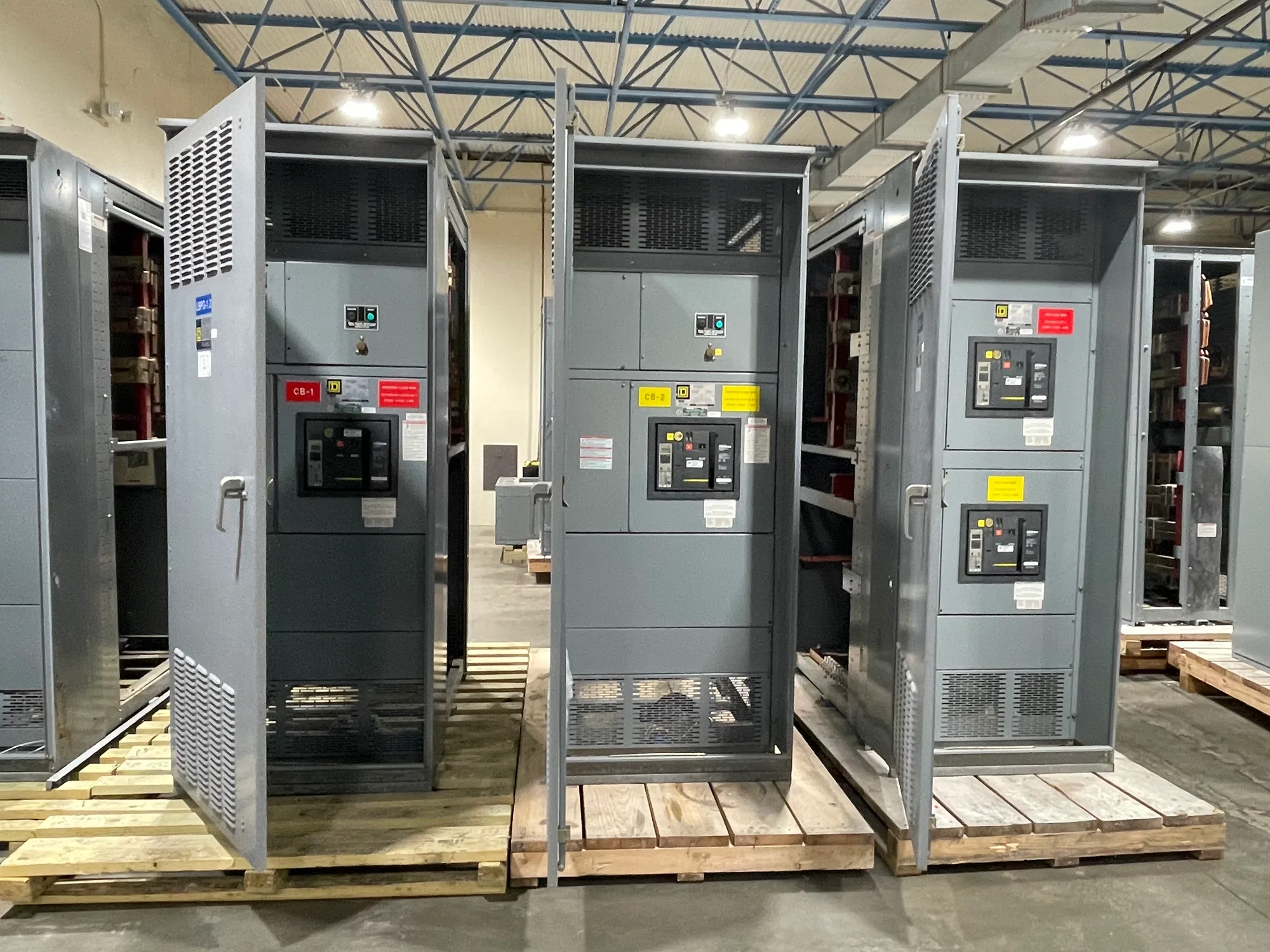
Map the Campus Distribution Role
A university switchboard may serve as a main distribution point for a building, a campus utility area, or a defined group of facilities. Begin by documenting its place in the one-line diagram: source, service or feeder function, downstream distribution, and any alternate sources that affect operating modes. Campus systems often evolve incrementally, so confirm whether the drawings reflect current field conditions rather than relying on legacy labels alone. Identify the buildings and major loads supplied, their normal operating schedules, and any constraints on interruption. This context helps establish the required bus arrangement, incoming and outgoing connections, and access needs without assuming one topology fits every institution. Coordinate planning with campus electrical staff, the consulting engineer, and the contractor responsible for installation. For a new project, renovation, or replacement, agree on the exact boundaries of work and interfaces with existing equipment before requesting a design or quotation.
Account for Varied Building Loads
University demand is shaped by more than classroom lighting and receptacles. Laboratories, residence halls, dining facilities, libraries, athletic spaces, research equipment, and central plant systems can have distinct load profiles and operating priorities. Compile available demand and load data by feeder, including known seasonal variation, planned equipment additions, and loads that require continuity or special operating procedures. Distinguish connected load from measured demand, and have qualified professionals establish the design values and applicable requirements. Consider characteristics such as motor starting, nonlinear loads, power quality concerns, and emergency or standby arrangements where relevant to the project. These factors can influence feeder allocation, protective-device selection, and coordination with upstream and downstream equipment. A clear load schedule is more useful than a single campus-wide estimate: it makes assumptions visible and gives reviewers a basis to identify overloaded paths, unused capacity, or conflicts before equipment layout and procurement are finalized.
| System | Voltage, phase, current and available fault current |
|---|---|
| Configuration | Lineup, protection, controls and enclosure as specified |
| Compliance | Applicable standards and listing confirmed for the assembly |
| Delivery | California and nationwide; schedule confirmed by quote |
Balance Circuit Space and Future Capacity
Future capacity is not simply an empty breaker position. A useful expansion plan considers available circuit spaces, bus and device ratings, enclosure dimensions, cable entry and bending space, heat dissipation, and the upstream source's ability to serve added demand. Ask facilities planners which projects are funded, which are probable, and which are longer-range possibilities; separate firm requirements from allowances so the design does not oversize equipment without a defined purpose. Reserve positions for likely feeders when practical, and document what assumptions govern any provision for future devices. Confirm that anticipated additions can be made safely and in accordance with the equipment design and applicable rules. Campus construction often proceeds in phases, but modifications to energized distribution require careful planning by qualified professionals. A well-defined growth strategy makes later projects easier to scope while avoiding the expectation that unused space alone guarantees additional electrical capacity.
Coordinate Protection, Interfaces, and Access
Protection and coordination decisions should be based on the complete distribution system, not the switchboard in isolation. Provide available fault-current information, source and transformer data, conductor details, downstream protective-device information, and any existing coordination or arc-flash study requirements for review. Qualified professionals determine appropriate ratings, protection settings, and applicable codes for each project; verify assumptions whenever campus sources or operating configurations can change. Also resolve practical interfaces: cable or busway entry direction, conduit locations, metering needs, control wiring, grounding, ventilation, working clearances, and the route from receiving to the final room. University buildings may have restricted access, occupied spaces, narrow service routes, or limited outage windows. Share those constraints early, along with installation sequencing and campus safety procedures. Detailed coordination reduces the risk of a design that meets an electrical objective but proves difficult to deliver, connect, maintain, or expand in its actual setting.
Prepare a Complete Project Package
A focused inquiry helps the manufacturer and project team evaluate a university switchboard against real site conditions. Provide the latest one-line diagram, equipment schedules, load data, source characteristics, required voltage and current values, fault-current information, feeder list, and applicable project specifications. Identify the equipment's intended location, environmental conditions, access limitations, connection preferences, and any required interface with existing assemblies. State which drawings or studies are preliminary and which govern procurement, and flag pending decisions that could affect configuration. For medium- or high-voltage equipment, identify and verify the standards applicable to that specific equipment; requirements vary by equipment and project. Where applicable, UL 891 concerns low-voltage switchboards, and its relevance should be confirmed for the project rather than assumed to establish a third-party listing. Switchgear Builder California builds new equipment in the USA with American components and supplies customers in California and nationwide. Schedule-sensitive options can be discussed during project review, without assuming a particular delivery date or configuration.